





Enhancement and automation of the file exchange platform
The DigitalMara team transformed a complex document processing system by implementing advanced data storage and automation. This approach streamlined data management, reduced inefficiencies, and improved workflow accuracy.

About the client
Independent pharmacies advocacy partner from the US
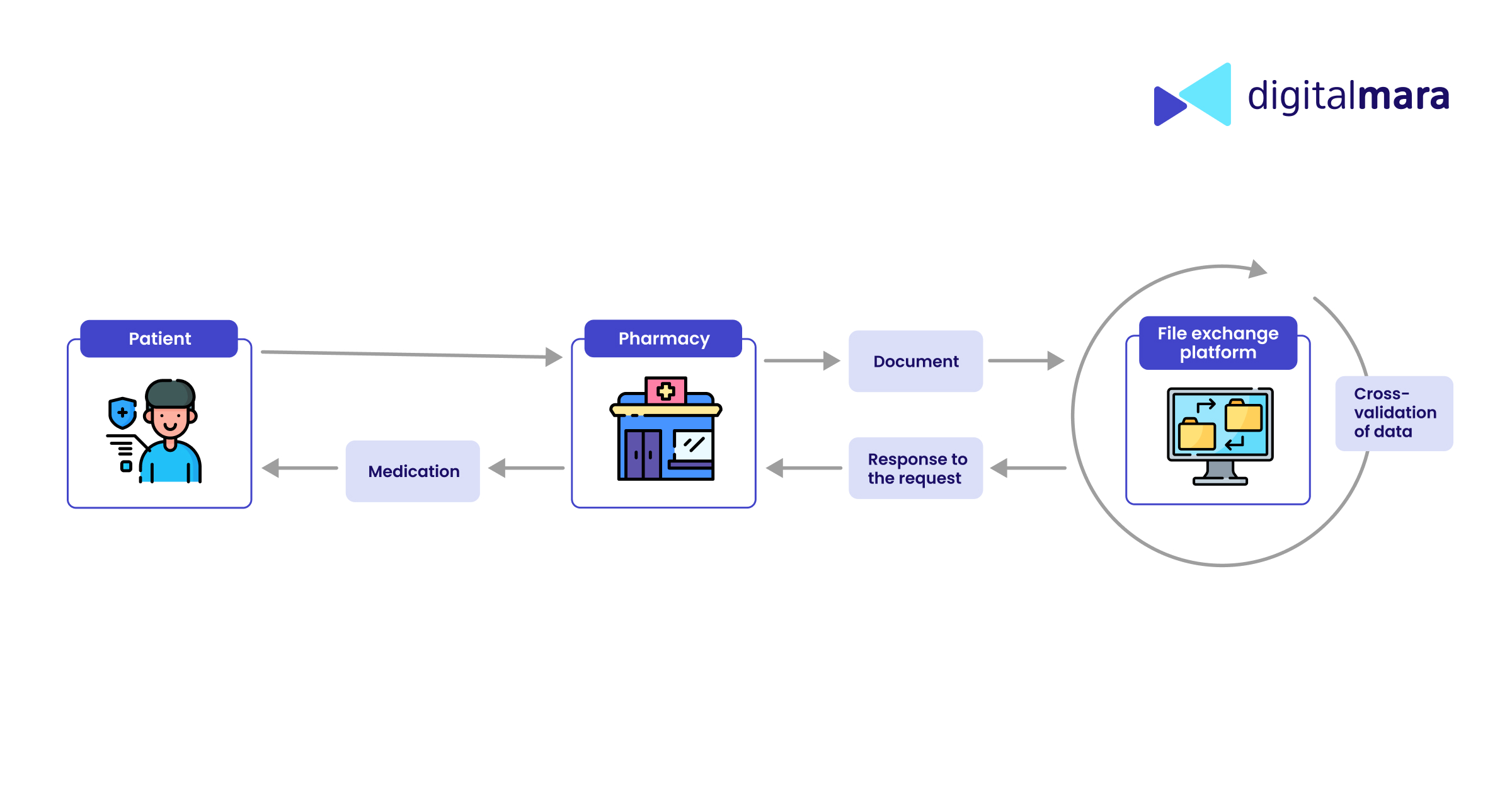
Our client provides comprehensive support and services for independent pharmacies in the USA. Among their key offerings is a software system for specific documents processing that ensures accuracy and transparency. Pharmacies submit patients' queries, and our client cross-references this data notifying all parties of the audit results.
Challenge
The system functions as a file exchange platform, where documents are processed on their server, allowing their clients to receive new files with required info. Meanwhile, the original documents are maintained in paper form, electronic form in pdf or EDI text file. To ensure proper processing, these physical documents must be converted into the appropriate digital format for further usage.
A key aspect of the system includes handling documents of a certain standard. These specific forms need to be accurately converted and integrated for proper workflow automation. Another challenge is the system's accumulation of large volumes of data over 13 years. Much of this data has not been accessed for an extended period and, in some cases, is even duplicated, leading to inefficiencies in storage and data management.
Approach
Our primary focus was on archiving existing data and optimizing data storage. We implemented a distributed database solution, organizing the data efficiently by storing 10 years of historical data in one location, while keeping the most recent three years of active data in a separate, easily accessible repository. In addition, unnecessary data has been deleted.
To further enhance the system’s performance, we redesigned the Extract, Transform, and Load (ETL) processes. This involved streamlining and optimizing the data flow, ensuring that files are efficiently converted into the correct storage format and easily accessed for analysis. We also automated several tasks using Directed Acyclic Graphs (DAGs).
It is worth mentioning that the client does not receive raw data but is handled by the external processor. The task was to double-check their version and whether it was uploaded correctly to the client’s server. So that there is no mixing of information from different pharmacies and patients.

Results
As a result, all tasks were successfully completed, leading to significant improvements in efficiency. Through the implementation of data archiving, the amount of storage space consumed has been reduced by 80%, optimizing overall system performance. Additionally, the introduction of automated data archiving lays the foundation for future scalability, ensuring that data management can be handled seamlessly and more efficiently moving forward.
Get case study as PDF
Thank you
The PDF has been sent to you via email. If you have any questions, please don't hesitate to reach out to us.
Similar case studies

Similar case studies
Evolution of the search algorithm for a proprietary insights platform
Similar case studies

Similar case studies
Restoring documentation and reinforcing a social care platform
Similar case studies

Similar case studies
Enchasing of management platform with a payroll functionality